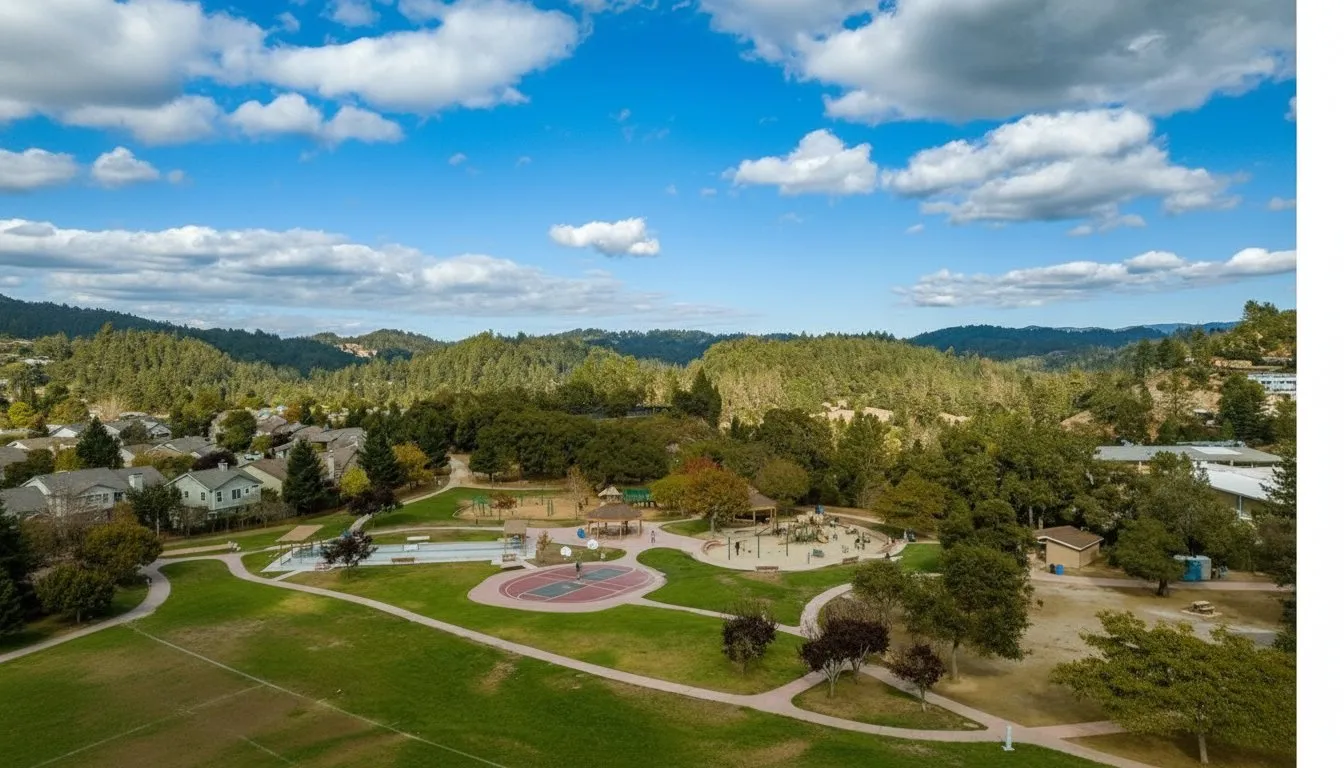
Scotts Valley is the neighborhood that wins on spreadsheets. Shortest commute to Silicon Valley in the county. Top-rated schools. Median price below the coastal premium neighborhoods. Redwood forest setting. On paper, it is the obvious choice for a tech worker with kids and a hybrid schedule. The reason it does not dominate every conversation is that it trades the beach lifestyle for a suburban one. There is no surf check before work, no sunset walk along the cliffs. Instead, there are clean sidewalks, a town center with a Safeway and a Starbucks, and the sound of wind through tall trees. For families who prioritize logistics over coastal romance, that exchange works perfectly.
Scotts Valley has a long history with tech. The town was home to Borland International and Santa Cruz Operation in the 1990s, and that legacy left behind a base of technology professionals who never left. Today, the neighborhood’s proximity to Highway 17 makes it the default landing zone for engineers, managers, and product leads at Apple, Google, and Netflix who want to live on the Santa Cruz side of the mountains without maximizing their drive time. The local population is educated, family-oriented, and, during work hours, largely staring at screens in home offices scattered across the tree-lined neighborhoods.
Commute to Silicon Valley
This is where Scotts Valley separates from every other neighborhood. The on-ramp to Highway 17 is minutes from most homes, and the descent into Silicon Valley takes 25 to 35 minutes. Apple Park in Cupertino is 25 to 30 minutes on a normal morning. Google in Mountain View runs 30 to 35 minutes. Netflix in Los Gatos is the shortest at 20 to 25 minutes, barely enough time to finish a podcast episode. Meta in Menlo Park is the outlier at 40 to 50 minutes, but that is still faster than starting from any coastal neighborhood.
The Highway 17 advantage is not just about the clock. Starting from Scotts Valley means you skip the Highway 1 merge that slows down commuters from Santa Cruz, Capitola, and Aptos. You are already on Highway 17 when they are still navigating surface streets. That head start matters most during peak hours and rainy days, when the coastal approach to Highway 17 can add 15 to 20 minutes of stop-and-go. The trade-off is that Scotts Valley sits at about 800 feet of elevation in the mountains, so fog and occasional winter frost are part of the morning routine, but the road from Scotts Valley southward to the valley floor is the gentler side of the mountain pass.
Housing for Tech Budgets
Scotts Valley’s median home price of $1.35 million places it in the moderate range for Santa Cruz County. You pay less than Aptos ($1.85M), Westside ($1.65M), and Pleasure Point ($1.55M), while getting larger lots and newer construction. The neighborhood developed primarily from the 1970s through 2000s, so the housing stock trends toward suburban homes with two-car garages, established landscaping, and layouts that assume families with children.
A budget of $1.2 to $1.5 million buys a three- to four-bedroom home with 1,800 to 2,400 square feet, a flat usable yard, and a quiet cul-de-sac setting. Newer builds and remodeled homes in the $1.5 to $1.8 million range add upgraded finishes, open floor plans, and energy-efficient systems. Compared to the valley, the value is dramatic: $1.35 million in Scotts Valley buys a home that would cost $2.2 to $2.8 million in Los Gatos, which is literally on the other side of the same mountain. Many tech families run exactly this comparison and make the move within a month.
Remote Work Setup
Internet infrastructure in Scotts Valley is strong for a semi-rural setting. Xfinity covers the town with cable speeds up to 1.2 Gbps. AT&T offers Fiber in the newer developments and DSL elsewhere. Cruzio, a local Santa Cruz ISP, also provides service in parts of Scotts Valley with competitive speeds and local customer support. Given the concentration of tech professionals in the area, providers have invested accordingly.
The co-working and cafe options within Scotts Valley itself are limited. The town center has a few coffee shops, including a Peet’s Coffee and local spots, but there is no dedicated co-working facility. Most remote workers in Scotts Valley build proper home offices. The homes are large enough to support a dedicated room with a door that closes, and many properties have bonus rooms, finished garages, or detached structures that convert into work spaces. For those who want a change of scenery, downtown Santa Cruz and its co-working options are about 15 minutes south.
The honest pitch for Scotts Valley is not glamorous: it is the practical choice. You get the fastest commute, the best schools, a home with room for a real office, and reliable internet. You give up the beach-town atmosphere, the walkability, and the cultural energy. For tech families who are done romanticizing the commute and want a neighborhood that simply works, Scotts Valley is the answer.
Frequently Asked Questions
- Why is Scotts Valley the most popular neighborhood for Silicon Valley commuters?
- Scotts Valley sits directly on Highway 17, cutting 10 to 15 minutes off the commute compared to coastal neighborhoods. At 25 to 35 minutes to Apple and Google, it offers the shortest drive in the county. Combined with top-rated schools and a median price below Aptos and Westside, it is the pragmatic choice for families who commute regularly.
- Does Scotts Valley feel suburban compared to beach neighborhoods?
- Yes. Scotts Valley is inland, nestled in the redwoods about 15 minutes from the coast. It lacks the surf culture and beach walkability of Pleasure Point or Capitola. What it offers instead is quiet streets, excellent schools, larger lots, and a commute that does not punish you. Many tech families see that as the right trade-off.